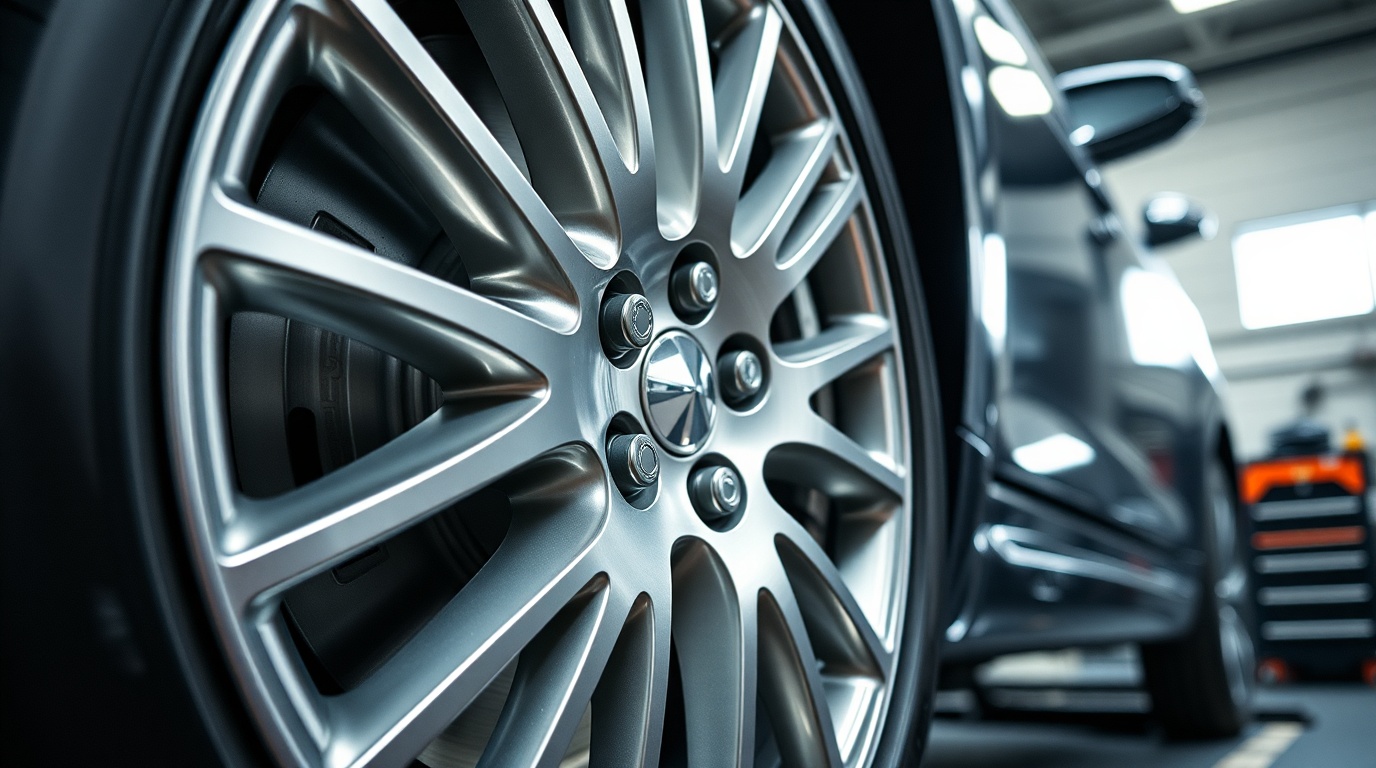
The short answer
It depends on the job. A full refurbishment — stripping back to bare metal, repairing, then powder coating or diamond cutting — needs the wheels off the car and usually the tyres off the wheels too, because the wheel goes through blasting, an oven or a CNC lathe. A mobile cosmetic kerb repair is normally done with the wheel still on the car, masking a small area to fill and re-spray a scuff. So the rule of thumb is: a complete refinish requires the wheels removed and taken to a workshop; a light, localised repair can be done in place on your driveway.
Whether your wheels have to leave the car comes down to the depth of the job. A complete strip-and-recoat and a quick scuff repair are very different processes with different requirements.
Wheels on or off
- Full strip and recoatWheels off, taken to workshop
- Powder coat / diamond cutWheels off (oven / lathe)
- Mobile kerb repairWheel usually stays on
- TyresOff for full refurb, masked for repair
- After refitRe-torque and re-balance as needed
When the wheels must come off
A full refurbishment puts the wheel through processes that simply cannot happen while it is bolted to the car:
- Media or shot blasting and chemical stripping need the bare wheel handled on its own.
- Powder coating cures the finish in an oven, which the wheel must enter on its own, with no tyre fitted.
- Diamond cutting mounts the wheel on a CNC lathe to machine the face — impossible with the wheel on the car.
- Full rim-edge repair requires access all the way to the bead, which means the tyre comes off too.
So for any genuine full refinish, the wheels are removed from the car and taken to the workshop. The car may be left on the road with a spare or temporary wheels, or owners sometimes do the job in stages so the car stays usable. After the refurbished wheels are refitted, they should be torqued to spec and, where tyres were removed, re-balanced.
When a repair can be done with wheels on
A mobile cosmetic repair is the main case where the wheel stays on the car. The technician comes to you, masks the tyre and surrounding area, and repairs a localised scuff or gouge by filling, sanding, priming, spraying and lacquering just that area. Because only a small patch is being worked on, there is no need to remove the wheel.
This approach is well suited to light kerb damage on one or two corners, and it has the obvious convenience of being done at your home or workplace. Its limitation is that it cannot fully treat the rim edge or carry out a complete refinish, because the tyre is still in place covering the lip and bead.
| Process | Wheels off? | Tyres off? | Where |
|---|---|---|---|
| Full strip and recoat | Yes | Yes | Workshop |
| Powder coat refurbishment | Yes | Yes | Workshop (oven) |
| Diamond-cut refinish | Yes | Yes | Workshop (CNC lathe) |
| Mobile cosmetic kerb repair | No | No (masked) | Your home / workplace |
Indicative guidance — depends on damage extent and finish chosen.
What removing the wheels means in practice
If your job needs the wheels off, a few practical points are worth knowing:
- Vehicle access — you will usually drop the car or just the wheels at the workshop, or arrange collection. Some refurbishers offer a courtesy set of wheels so the car stays mobile.
- TPMS sensors — wheels with tyre-pressure monitoring sensors need care when the tyre is removed and refitted, so the sensor is not damaged.
- Locking wheel nuts — make sure the locking wheel nut key is available, or the wheels cannot be removed.
- Re-torque check — after refitting, the nuts should be torqued correctly, and a re-torque check after a short drive is good practice.
The bottom line: a complete refinish needs the wheels off and is a workshop job; a light cosmetic repair can be done in place. Match the method to the damage and you get the right balance of cost, convenience and durability.
Doing the wheels in stages versus all at once
One question that follows from a wheels-off refurbishment is how to keep the car usable. There are a few common approaches:
- All four at once with courtesy wheels. Some refurbishers lend a set of temporary wheels so you drive away while yours are done. This gives an even, matched finish across all four and the shortest overall project, but depends on the workshop offering loan wheels.
- Drop the wheels only. If you have a second vehicle or can arrange a lift, you can leave just the wheels (or the whole car) at the workshop. This is simple but leaves you without the car or wheels for the turnaround.
- In stages, a wheel or two at a time. Owners who must keep the car on the road sometimes do one or two corners, refit them, then return for the rest. This keeps the car mobile throughout but means more than one visit and a slightly longer overall timeline.
The right choice depends on whether your priority is a matched set done together, keeping the car usable, or minimising visits. For a cosmetic mobile repair none of this arises, because the wheel stays on the car and the work happens at your home or workplace. The practical takeaway is to discuss vehicle access with the refurbisher when booking: a full refinish needs the wheels off and away, so planning how you manage without them avoids being caught out, while a light scuff can be tidied in place with no disruption at all.
It also helps to think about the trade-off the wheels-off requirement reflects. The reason a full refurbishment needs the wheels removed is precisely what makes it last: only with the wheel off the car and the tyre off the wheel can the rim edge be stripped, repaired and sealed properly, and only off the car can it be blasted, oven-cured or machined on a lathe. So the inconvenience of being without the wheels for a day or two buys a far more thorough and durable result than any in-place repair can give. A wheels-on mobile repair trades that thoroughness for convenience, which is the right call for a light cosmetic scuff but the wrong one for tired, corroded or rim-edge-damaged wheels. Deciding which you have is the key to choosing between the two.
Frequently asked questions
Can a full refurbishment be done with the wheels on the car?
No. A full strip-and-recoat involves blasting, oven curing or CNC machining, all of which need the wheel removed from the car and handled on its own. Only localised cosmetic repairs are done with the wheel still fitted.
Will I be without my car during a wheels-off refurbishment?
Not necessarily. Many owners do the wheels in stages, leave the car on temporary or courtesy wheels, or just drop the wheels at the workshop. Arrangements vary, so ask the refurbisher how they handle vehicle access during the job.
Do I need the locking wheel nut key for a refurbishment?
Yes, if your car has locking wheel nuts. The workshop cannot remove the wheels without the matching key, so it is one of the most common causes of a delayed job. Check you have the key before your booking.
Sources & further reading
Figures on this page are typical UK ranges drawn from published sources and depend on your specific wheels. They are guidance, not a quotation.